鄭哥,90年代大學畢業,26年橫跨電子,家電、服裝、珠寶、教育、AI算力多個行業。做過中學教師、翻譯、外贸,現在搞七善門科技和星辰算力。口頭禪:「點解唔得?」Hany, university grad from the 90s, 26 years across electronics, appliances, fashion, jewelry, education, and AI compute. Former teacher, translator, trader. Now running Qishanmen Tech and Star Compute. Catchphrase: "Why not?"
Last night I received a WhatsApp from my old friend Ah-Chang, took a quick look at the news — AMD acquiring World Labs founded by Fei-Fei Li for $8.2 billion. After 26 years in export, I've seen plenty of M&A deals, but this one, I had to write about.
Who is Fei-Fei Li? The godmother of computer vision, founder of ImageNet, someone who's moved between Google Cloud and Stanford, now turning to AI research. $8.2 billion — 55 billion RMB — for an AI lab. Do people understand what this number means?
AMD's second-largest acquisition in history, only behind the 2022 $50B Xilinx deal. Now tell me, why is an AI model lab worth $8.2B?
Act 1: The Numbers on Wall Street — What's Behind the $8.2B
AMD issued its press release on Monday (September 28) on its official website, all-stock transaction, expected to close by year-end. Lisa Su personally came out to explain: "Building compute platforms for the next generation of AI requires deep understanding of how models evolve. What Fei-Fei Li and the World Labs team bring in research leadership and model expertise is exactly what we need."
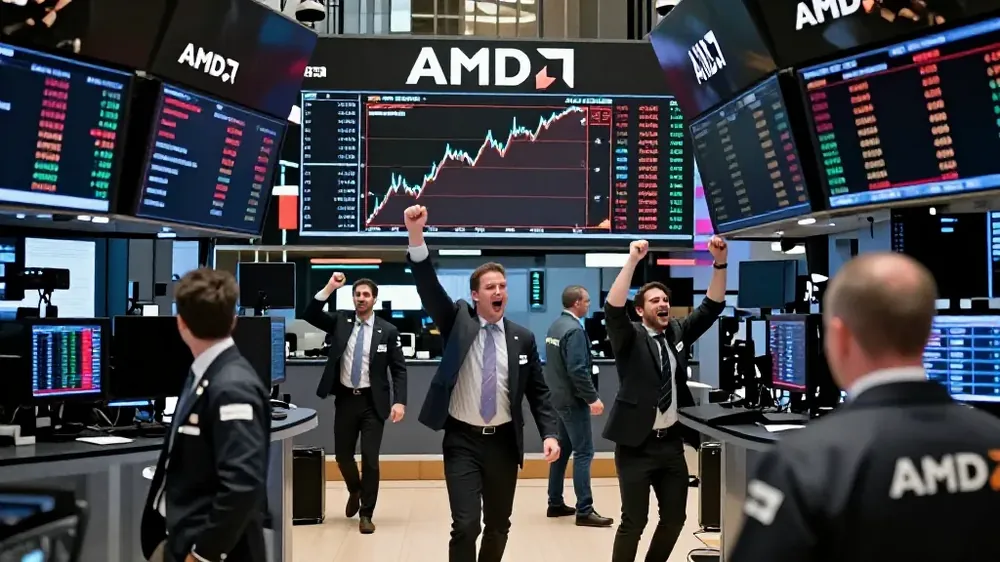
場景一:華爾街交易廳Scene 1: Wall Street trading floor — AMD stock surges, AI chip sector rallies Image AI-assisted (Z-Image-Turbo)
Fei-Fei Li's response was equally direct: "Joining AMD will give our team resources and engineering depth to accelerate research and help define the infrastructure needed for the AI era."
When I read this, I immediately thought of a chip factory owner I met in Shenzhen in 2017. He told me: "Chinese people doing semiconductors, we're always playing catch-up. But we have the market, the people, the application scenarios." Ten years later, today's situation — AMD spending 55 billion buying an AI model lab — fully confirms what he said: hardware companies are willing to pay geometric-level premiums for software capabilities.
Act 2: Ah-Chang's Question — How Much Is Fei-Fei Li's Team Really Worth?
Ah-Chang is an AI engineer I've known for years in Shenzhen, specializing in chip design automation. He WhatsApp'd me: "Zheng Ge, what does World Labs actually do? Is $8.2B worth it?"
I told him: look it up yourself.
What he found: September 2024, Fei-Fei Li announced World Labs raised $230M at about $1B valuation. February 2026, a new round of $1B raised — valuation not disclosed, but the investor list included a16z, Radical Ventures, plus NVIDIA, AMD, and Autodesk.
場景二:老友WhatsApp討論Scene 2: Friends discussing on WhatsApp — how much is World Labs really worth? Image AI-assisted (Z-Image-Turbo)
The investor list is the key: why would hardware vendors like NVIDIA and AMD invest in an AI model company?
The answer is simple: AI models determine hardware requirements. If you don't control the direction of upstream models, hardware vendors are like dumping huge capital to build factories without knowing what specs the customers actually want.
Ah-Chang said: "So Lisa Su isn't buying Fei-Fei Li the person, she's buying her judgment on where AI models are going?"
I said: "Something like that."
Act 3: Data Centers — Chinese Giants Aren't Losing
While Wall Street was doing its acquisition, China didn't stand still either.
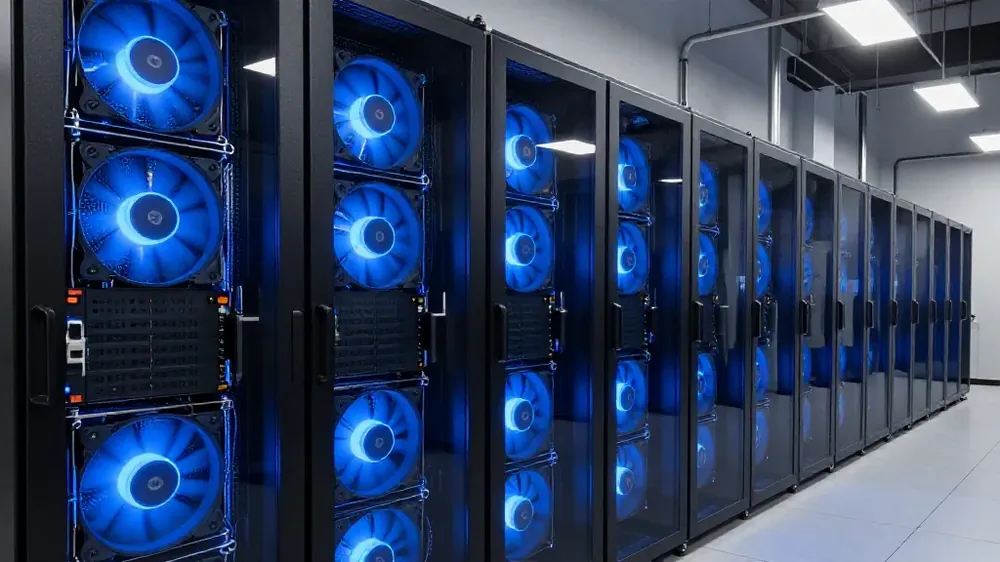
Alibaba Cloud announced at the Yunqi Conference: target to exceed 20GW of global data center capacity by 2032. 20GW — what does this number mean? It means equivalent to about 20 standard coal-fired power plants' generating capacity, all used for AI computing.
場景三:中國數據中心Scene 3: Chinese data center — AI server cluster, power reaching 20GW scale Image AI-assisted (Z-Image-Turbo)
Wu Yongming at the same event said: "The total machine thinking will reach over 1000 times that of humans in the future." He defined AI models, AI chips, and AI cloud as "the three cornerstones of the machine intelligence era."
When I heard this, my first reaction was: bold. But thinking deeper, when Taobao back then said "making it easy to do business anywhere," everyone said they were吹牛皮. How about today?
Act 4: Zheng Ge's Take — What Are We Actually Fighting For in the AI Arms Race?
Summarizing what I saw today, I drew a line for Ah-Chang:
US: AMD acquires World Labs -> hardware vendor controls upstream model -> locks in software stack
China: Alibaba 20GW data center -> Wu Yongming's "1000x machine thinking" -> infrastructure first
Two paths, which one works?
My judgment: short-term, the US model takes effect faster — Lisa Su is buying talent, Fei-Fei Li's team can immediately work on AMD's GPUs. Long-term, the China model has stronger stamina — 20GW scale can't be built overnight through acquisitions, it requires time to accumulate.
But the most critical variable isn't hardware, isn't software, it's application scenarios — whoever can monetize AI is the final winner.
AMD's $8.2B acquisition of World Labs isn't one company's business — it's the signal that the M&A era of the entire AI industry has officially begun.
關於作者About the Author
鄭哥,90年代大學畢業,26年橫跨電子,家電、服裝、珠寶、教育、AI算力多個行業。做過中學教師、翻譯、外贸,現在搞七善門科技和星辰算力。口頭禪:「點解唔得?」Hany, university grad from the 90s, 26 years across electronics, appliances, fashion, jewelry, education, and AI compute. Former teacher, translator, trader. Now running Qishanmen Tech and Star Compute. Catchphrase: "Why not?"